

≥99%
910463-68-2
4113.58 g/mol
Peptides. Deep Dive
Research-based Podcast
Semaglutide
How semaglutide works in research
An average rating of 4.6/5 from verified customer feedback
Semaglutide
GLP-1 receptor agonist researched for glycemic control and body weight regulation.
- Buy3+for$94.05each andsave 5%
- Buy5+for$89.10each andsave 10%
- Buy10+for$84.15each andsave 15%
Peptides. Deep Dive
Research-based Podcast
Semaglutide
How semaglutide works in research
An average rating of 4.6/5 from verified customer feedback
Characteristics
| Property | Value |
|---|---|
| Molecular Formula | C₁₈₇H₂₉₁N₄₅O₅₉ |
| CAS Number | 910463-68-2 |
| Molar Mass | 4113.58 g/mol |
| Amino Acid Sequence | Modified GLP-1 (7-37) analog with Aib8, Arg34, and C-18 fatty di-acid acylation at Lys26 |
| Synonyms | NN9535, GLP-1 receptor agonist analog |
| Physical Form | Lyophilized powder |
| Solubility | Soluble in water at physiological pH |
| Organoleptic Profile | White to off-white lyophilized powder; odorless |
| Storage Conditions | Store lyophilized at 2-8°C; protect from light; reconstituted solution stable at 2-8°C |
| Composition | Lyophilized semaglutide base |
How is Semaglutide Used in Research?
Semaglutide is a long-acting glucagon-like peptide-1 (GLP-1) receptor agonist. It is a modified analog of GLP-1 (7-37) with three key structural modifications: an aminoisobutyric acid (Aib) substitution at position 8 that confers resistance to dipeptidyl peptidase-4 (DPP-4) degradation, an arginine substitution at position 34, and a C-18 fatty di-acid chain acylated to lysine at position 26 that enables strong non-covalent albumin binding and extends the plasma half-life to approximately 7 days.
Mechanistically, semaglutide activates GLP-1 receptors in pancreatic beta cells to enhance glucose-dependent insulin secretion, suppresses glucagon release, delays gastric emptying, and acts on hypothalamic GLP-1 receptors to reduce appetite and caloric intake. These properties make it a subject of extensive preclinical research across metabolic, cardiovascular, and neurological models.
Emerging preclinical research has explored GLP-1 receptor agonism in models of Alzheimer's disease and Parkinson's disease, suggesting potential neuroprotective properties through anti-inflammatory and anti-apoptotic mechanisms. In vitro studies have also demonstrated effects on hepatic lipid metabolism and steatosis models.
This product is supplied in a lyophilized form and requires reconstitution prior to laboratory handling. For research and laboratory use only. Not for human or veterinary consumption.
Areas of Study
Glycemic Regulation
Studied for glucose-dependent insulin secretion enhancement through pancreatic beta cell GLP-1 receptor activation in metabolic research models.
Appetite & Energy Balance
Investigated for body weight reduction through central GLP-1 receptor activation in hypothalamic appetite-regulating circuits in preclinical models.
Cardiovascular Mechanisms
Preclinical research explores GLP-1 receptor-mediated effects on endothelial function, inflammation, and atherosclerotic plaque stability.
Hepatic Lipid Metabolism
Investigated for reduction of hepatic fat accumulation through improved insulin sensitivity and reduced de novo lipogenesis in preclinical steatosis models.
Neuroprotection
Emerging preclinical research explores GLP-1 receptor agonism for neuroprotective effects in models of Alzheimer's and Parkinson's disease.
References
- [1]Knudsen LB, Lau J. (2019). The discovery and development of liraglutide and semaglutide. Frontiers in Endocrinology, 10, 155.
- [2]Gabery S, Salinas CG, Paulsen SJ, et al. (2020). Semaglutide lowers body weight in rodents via distributed neural pathways. JCI Insight, 5(6), e133429.
- [3]Rakipovski G, Rolin B, Nøhr J, et al. (2018). The GLP-1 analogs liraglutide and semaglutide reduce atherosclerosis in ApoE-/- and LDLr-/- mice by a mechanism that includes inflammatory pathways. JACC: Basic to Translational Science, 3(6), 844-857.
Disclaimer: The information provided is for research reference only and does not constitute medical advice. Products are sold strictly for in-vitro research use.
Certificate of Analysis (COA)
Third-Party Verified Quality
Every batch of Semaglutideis independently tested by an accredited third-party laboratory. Our COAs include HPLC purity analysis, mass spectrometry identity confirmation, and batch-specific lot numbers. We publish these results publicly so you can verify exactly what you're getting.
View Lab ResultsGet the Full Research Guide
“Stillwater BioLabs: Evidence-Based Peptide Research” — our comprehensive guide covering peptide handling, reconstitution best practices, storage protocols, and research methodology. Free for all members.
Free forever. No credit card required. Instant access to research tools, exclusive content, and member pricing.
Related Products
 Popular
Tirzepatide
Dual GIP/GLP-1 receptor agonist studied for metabolic regulation and weight management.

Retatrutide
Triple-agonist peptide targeting GIP, GLP-1, and glucagon receptors for metabolic research.
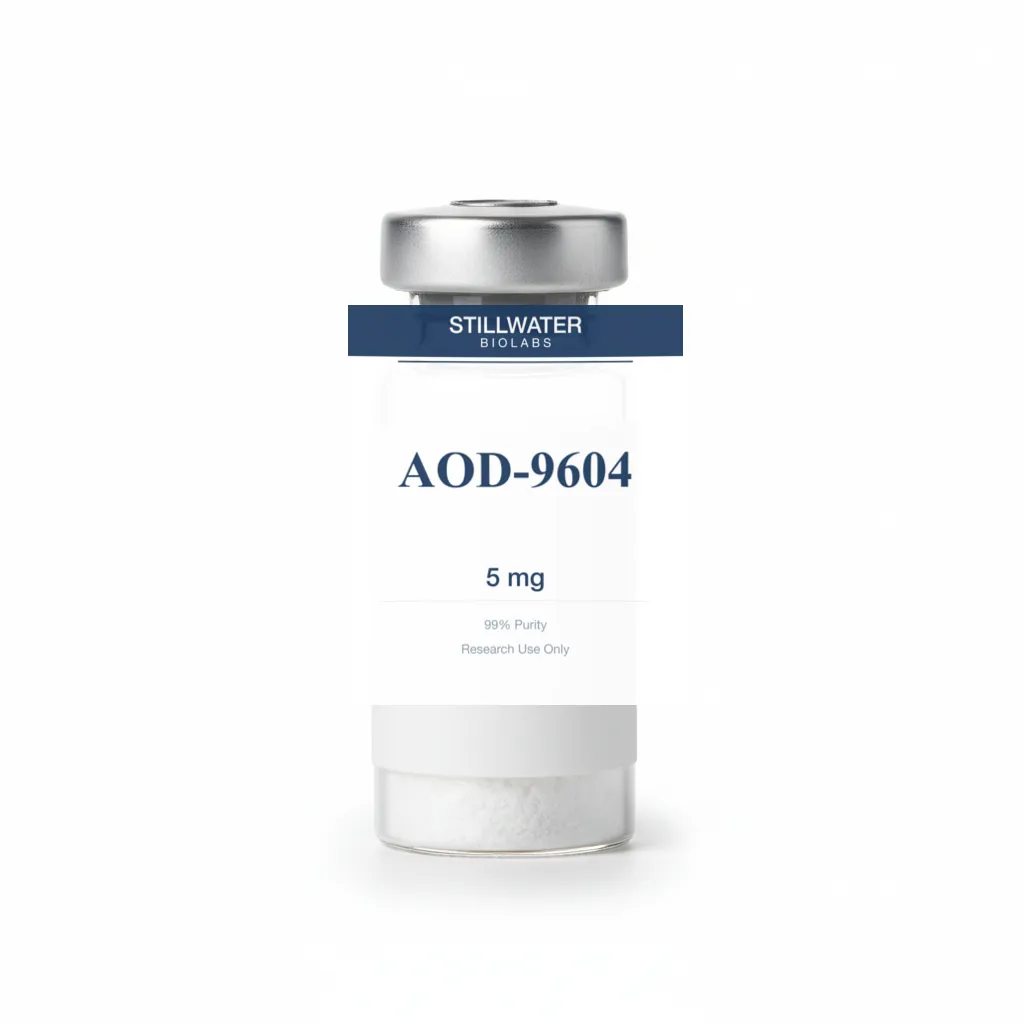
AOD-9604
A modified fragment of human growth hormone (hGH 177-191) studied for fat metabolism.

Cagrilintide
A long-acting amylin analog studied for appetite regulation and metabolic research.
Frequently Bought Together
Semaglutide
5mg
$99
Tirzepatide
10mg
$149
Retatrutide
10mg
$179
Bundle total
$427