
≥99%
Peptides. Deep Dive
Research-based Podcast
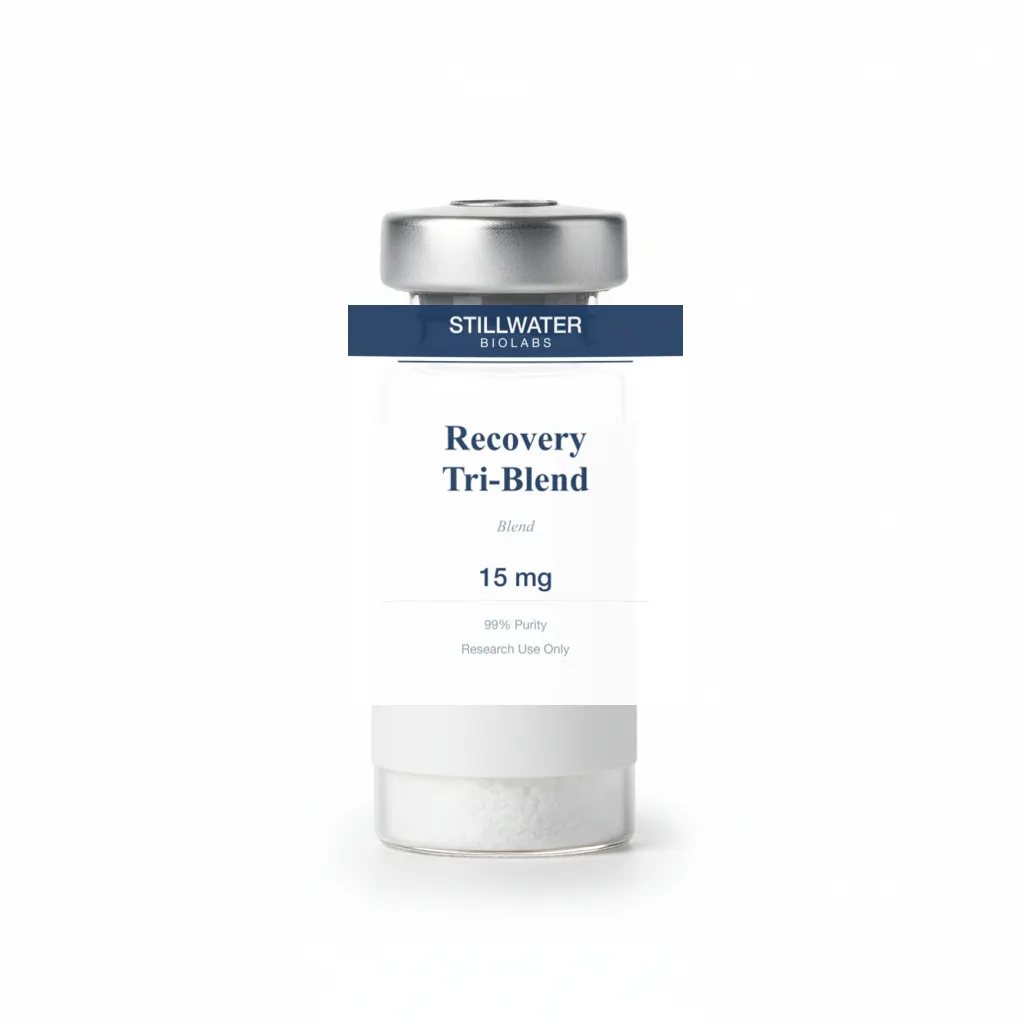
Recovery Tri-Blend
How recovery tri-blend works in research
An average rating of 4.7/5 from verified customer feedback
Recovery Tri-Blend
Triple-action recovery blend: BPC-157 + TB-500 + GHK-Cu for comprehensive tissue repair research.
- Buy3+for$113.05each andsave 5%
- Buy5+for$107.10each andsave 10%
- Buy10+for$101.15each andsave 15%
Peptides. Deep Dive
Research-based Podcast
Recovery Tri-Blend
How recovery tri-blend works in research
An average rating of 4.7/5 from verified customer feedback
Characteristics
| Property | Value |
|---|---|
| Components | BPC-157 + TB-500 + GHK-Cu |
| BPC-157 Molecular Formula | C₆₂H₉₈N₁₆O₂₂ (1419.53 g/mol) |
| TB-500 Molecular Formula | C₂₁₂H₃₅₀N₅₆O₇₈S (4963.44 g/mol) |
| GHK-Cu Molecular Formula | C₁₄H₂₃N₃O₄·Cu (403.93 g/mol) |
| Physical Form | Lyophilized powder blend |
| Solubility | All components soluble in water and bacteriostatic water |
| Organoleptic Profile | Light blue to off-white lyophilized powder (blue hue from copper complex); odorless |
| Storage Conditions | Store lyophilized at -20°C; protect from light; reconstituted solution stable at 2-8°C |
| Composition | Lyophilized blend of BPC-157 acetate, Thymosin Beta-4 acetate, and GHK-Cu complex |
How is Recovery Tri-Blend Used in Research?
The Recovery Tri-Blend combines three peptides — BPC-157, TB-500, and GHK-Cu — each with distinct and well-documented mechanisms of action in tissue repair, wound healing, and regeneration. This three-component formulation addresses tissue recovery through complementary molecular pathways: BPC-157's nitric oxide modulation and VEGF-driven angiogenesis, TB-500's actin-mediated cell migration and laminin-5 upregulation, and GHK-Cu's broad gene expression modulation of collagen synthesis, antioxidant defense, and extracellular matrix remodeling.
The inclusion of GHK-Cu adds a dimension not present in the BPC-157/TB-500 dual blend. GHK-Cu has been shown to regulate over 4,000 human genes (per Broad Institute Connectivity Map analysis), including those involved in collagen I, III, and IV synthesis, elastin production, decorin expression, and metalloproteinase regulation. It also induces superoxide dismutase and other antioxidant enzymes, providing oxidative stress protection at injury sites. The copper ion itself serves as a cofactor for lysyl oxidase, an enzyme critical for collagen and elastin cross-linking. This extracellular matrix optimization complements BPC-157's vascularization and TB-500's cell recruitment activities.
The theoretical framework for this tri-blend follows a sequential tissue repair model: TB-500 promotes initial cell migration and recruitment to the injury site, BPC-157 drives angiogenesis to vascularize the repair zone and provides anti-inflammatory protection, and GHK-Cu optimizes the extracellular matrix architecture of the repaired tissue while providing antioxidant defense. While no single study has examined all three peptides together, the extensive individual literature (hundreds of publications across the three compounds) provides a robust scientific basis for investigating their combined effects.
This product is supplied in a lyophilized form and requires reconstitution prior to laboratory handling. For research and laboratory use only. Not for human or veterinary consumption.
Areas of Study
Multi-Pathway Tissue Repair
Combines angiogenesis (BPC-157), cell migration (TB-500), and ECM remodeling (GHK-Cu) for comprehensive tissue repair research across complementary mechanisms.
Extracellular Matrix Optimization
GHK-Cu's collagen synthesis and metalloproteinase regulation combined with BPC-157 and TB-500 wound healing for improved tissue architecture.
Antioxidant Defense at Injury Sites
GHK-Cu's SOD induction provides oxidative stress protection complementing the anti-inflammatory effects of BPC-157 and TB-500.
Musculoskeletal Recovery
All three peptides have individual preclinical evidence for muscle, tendon, ligament, or connective tissue healing through distinct pathways.
Skin & Dermal Regeneration
TB-500's keratinocyte migration, BPC-157's angiogenic activity, and GHK-Cu's collagen/elastin synthesis converge on comprehensive dermal repair.
References
- [1]Sikiric P, Seiwerth S, Rucman R, et al. (2018). Stable gastric pentadecapeptide BPC 157: novel therapy in gastrointestinal tract. Current Pharmaceutical Design, 24(18), 1990-2001.
- [2]Goldstein AL, Hannappel E, Sosne G, Kleinman HK. (2012). Thymosin β4: a multi-functional regenerative peptide. Basic properties and clinical applications. Expert Opinion on Biological Therapy, 12(1), 37-51.
- [3]Pickart L, Vasquez-Soltero JM, Margolina A. (2015). GHK peptide as a natural modulator of multiple cellular pathways in skin regeneration. BioMed Research International, 2015, 648108.
- [4]Maquart FX, Pickart L, Laurent M, et al. (1988). Stimulation of collagen synthesis in fibroblast cultures by the tripeptide-copper complex glycyl-L-histidyl-L-lysine-Cu²⁺. FEBS Letters, 238(2), 343-346.
- [5]Bock-Marquette I, Saxena A, White MD, et al. (2004). Thymosin β4 activates integrin-linked kinase and promotes cardiac cell migration, survival and cardiac repair. Nature, 432(7016), 466-472.
Disclaimer: The information provided is for research reference only and does not constitute medical advice. Products are sold strictly for in-vitro research use.
Certificate of Analysis (COA)
Third-Party Verified Quality
Every batch of Recovery Tri-Blendis independently tested by an accredited third-party laboratory. Our COAs include HPLC purity analysis, mass spectrometry identity confirmation, and batch-specific lot numbers. We publish these results publicly so you can verify exactly what you're getting.
View Lab ResultsGet the Full Research Guide
“Stillwater BioLabs: Evidence-Based Peptide Research” — our comprehensive guide covering peptide handling, reconstitution best practices, storage protocols, and research methodology. Free for all members.
Free forever. No credit card required. Instant access to research tools, exclusive content, and member pricing.
Related Products
 Best Seller
BPC-157
Body Protection Compound-157. A pentadecapeptide studied for tissue repair, gut healing, and angiogenesis.
TB-500
Thymosin Beta-4 fragment. Researched for its role in cell migration, wound repair, and anti-inflammatory activity.

Pentadecarginine
A BPC-157 analog with arginine salt form studied for enhanced stability and bioavailability.
 Best Value
BPC-157 + TB-500 Blend
A synergistic recovery blend combining BPC-157 and TB-500 for enhanced tissue repair research.
Frequently Bought Together
Recovery Tri-Blend
15mg (5mg/5mg/5mg)
$119
BPC-157
5mg
$42
TB-500
5mg
$45
Bundle total
$206